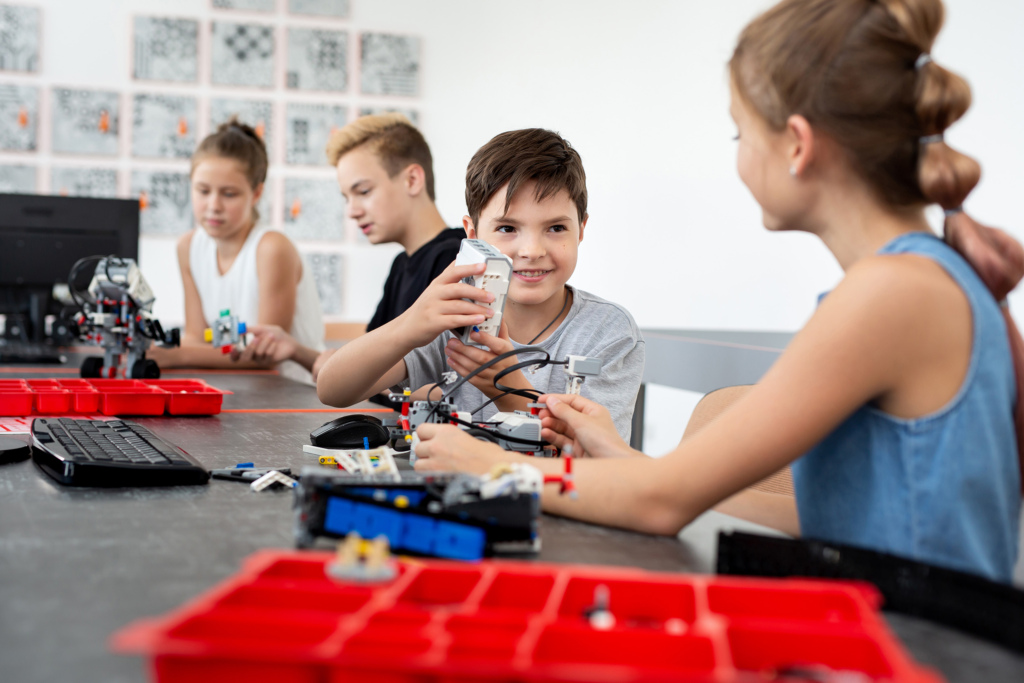

<p><span style="font-weight: 400">Playing is a vital aspect of childhood development. According to experts, playing is a raw way of education that improves cognitive, social, emotional, and physical development. Through play, kids learn various skills that help them later in life. Children attending the best kindergarten schools in Virginia Beach are exposed to an environment that fosters learning through play. Let&#8217;s dive deep and discuss what kids can learn from playing.</span></p>
<h2><span style="font-weight: 400">Cognitive Development</span></h2>
<p><span style="font-weight: 400">Cognitive development is imperative to a child&#8217;s development, and playing plays a vital role in enhancing cognitive skills. Children who play with diverse toys like building blocks, puzzles, and other games have the chance to learn and solve problems, thereby developing critical thinking skills. </span></p>
<p><span style="font-weight: 400">Children are exposed to a world of possibilities when they play with building blocks. They can create structures and shapes, requiring them to use their imagination and problem-solving skills. They must consider each block&#8217;s size, shape, and position to create something stable and aesthetically pleasing. Moreover, as they build, they encounter challenges such as balance, stability, and symmetry, which they must overcome to create a successful structure.</span></p>
<p><span style="font-weight: 400">They learn to identify patterns, analyze information, and draw conclusions, essential skills that will help them later. This encourages them to think creatively and develop new solutions to problems. </span></p>
<h2><span style="font-weight: 400">Social Development</span></h2>
<p><span style="font-weight: 400">This is another crucial element of a child&#8217;s development, and playing with other children is an incredible way to improve social skills. This enhances their social skills, which are essential in their later life when interacting with different people.</span></p>
<p><span style="font-weight: 400">Playing together also teaches children how to work as a team and cooperate. When children attend the best private elementary schools, they are exposed to various team-building activities, which help them develop social skills that will be beneficial throughout their lives. They also learn empathy, as when children play together, they learn to identify the feelings of others and respond appropriately. This skill is crucial in developing positive relationships and fostering community. Empathetic children are more likely to succeed in their personal and professional lives.</span></p>
<h2><span style="font-weight: 400">Emotional Development</span></h2>
<p><span style="font-weight: 400">Children learn more about their feelings and behavior when playing, which helps them behave better. They know how to express their feelings appropriately, enhancing their emotional intelligence. Children attending the best kindergarten schools in Virginia Beach are exposed to various expressive activities that promote emotional development, giving them a head start in their academic and personal lives.</span></p>
<p><span style="font-weight: 400">Playing pretends games is an excellent way to enhance empathy, which is the ability to understand and share the feelings of others. Children who play-act games learn to empathize with others and understand their perspectives. This skill is crucial in developing positive relationships and fostering community.</span></p>
<p><span style="font-weight: 400">Moreover, playing promotes resilience, which is the ability to bounce back from setbacks and challenges. Children engage in play, encounter challenges, and learn how to overcome them. </span></p>
<h2><span style="font-weight: 400">Physical Development</span></h2>
<p><span style="font-weight: 400">Children develop gross and fine motor skills using large and small muscles through these activities. Gross motor skills are essential for formulating physical coordination, balance, and strength. Physical activities help children develop strong muscles crucial for healthy physical development. Additionally, gross motor skills are vital in developing hand-eye coordination, which is essential for sports, driving, and playing musical instruments.</span></p>
<p><span style="font-weight: 400">Fine motor skills are crucial in developing precise hand movements, essential for writing, drawing, and other activities requiring accuracy and control. On the other hand, fine motor skills involve using small muscles, which help children develop coordination and dexterity. Playing with small objects, drawing, and cutting paper are all examples of fine motor activities that help children develop these skills.</span></p>
<p><span style="font-weight: 400">Physical play is also crucial for promoting overall physical health and wellness. Regular physical activity helps children develop strong bones and muscles essential for healthy growth and development.</span></p>
<h2><span style="font-weight: 400">Language Development</span></h2>
<p><span style="font-weight: 400">Playing is an important activity for language development in children. When children engage in imaginative play, such as playing house, they learn to use language in different contexts, enhancing their language development and communication skills. During pretend play, children use language to express their thoughts and ideas, which helps them develop their vocabulary and grammar skills.</span></p>
<p><span style="font-weight: 400">Imaginative play also encourages children to use their creativity and imagination to create new scenarios and ideas. This type of play can involve storytelling, which helps children develop narrative skills and effectively communicate ideas and information. </span></p>
<p><span style="font-weight: 400">Playing with toys and games that involve language and communication also helps children develop their language skills. For example, playing with puppets or dolls can help children learn to use different voices and expressions, enhancing their communication ability. Board games that involve communication, such as charades or Pictionary, can also help children develop their language and communication skills.</span></p>
<p><span style="font-weight: 400">By providing children with chances to engage in imaginative play and language-focused games and activities, parents and educators can help promote language development and encourage strong communication skills.</span></p>
<h2><span style="font-weight: 400">Conclusion</span></h2>
<p><span style="font-weight: 400">In conclusion, playing is essential to childhood development; children can learn much from it. Children can develop cognitive, social, emotional, physical, and language skills through play. These skills are essential for their later lives, and the benefits of playing can be long-lasting. Attending the </span><a href="https://strelitzinternationalacademy.org/ib-pyp-schools-chesapeake-va/"><span style="font-weight: 400">best private elementary schools in Chesapeake</span></a><span style="font-weight: 400"> can provide children with an environment that fosters learning through play, allowing them to develop these skills in a supportive and engaging environment. Encouraging kids to play and letting them experience diverse types of games can help them evolve into versatile individuals with a range of skills that will be valuable for them.</span></p>
<p> ;</p>

What Can Kids Learn From Playing?