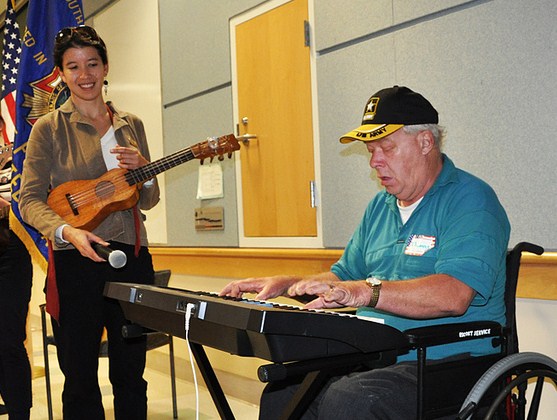

<p style="text-align: justify">Music therapy goes beyond using music as a recreational activity and is a research-based practice and profession dedicated to providing active support to improve the functioning, health and well-being of participants.</p>
<p style="text-align: justify">Music&#8217;s ability to &#8216;reach&#8217; people lost to other forms of social interaction has been repeatedly demonstrated in academic research and literature. Even so, it took an internet video-clip of &#8216;Henry&#8217;, an elderly man with dementia – viewed by millions – to bring this phenomena to the world&#8217;s attention. In this clip, &#8216;Henry&#8217; is shown to be totally withdrawn and unresponsive. However, when his headphones are put on, a remarkable transformation occurs. Just like switching on a light, he becomes alert and animated. Not just entertained, Henry is shown to be absorbed and engaged in the music, humming along to the performance.</p>
<p style="text-align: justify">Perhaps the most interesting feature of &#8216;Henry&#8217;s&#8217; engagement, which has implications for those who care for those with dementia and related conditions, is that these therapeutic effects continue for some considerable time after the music stimulus is removed. &#8216;Henry&#8217;, for example, could later respond to questions, and is shown singing extracts from his favourite songs.</p>
<p style="text-align: justify">Even though music has a remarkable ability to engage every kind of listener, music therapists and researchers stress music is not itself a cure. Nevertheless, in layman&#8217;s terms, music&#8217;s ability to communicate directly with human listeners, without demanding language skills, undoubtedly accounts for much of this success.</p>
<p style="text-align: justify">Physician Oliver Sacks, author of &#8216;Musicophilia: Tales of Music and the Brain&#8217;, commenting on &#8216;Henry&#8217;, said: &#8216;The philosopher [Immanuel] Kant once called music “the quickening art.” And Henry is being quickened. He&#8217;s being brought to life. The effect of this doesn&#8217;t stop when the headphones are taken off. In some sense, Henry is restored to himself. He has remembered who he is and he has reacquired his identity for a while through the power of music.&#8217;</p>
<h2 style="text-align: justify"><strong>Therapy For ALzheimer&#8217;s</strong></h2>
<p style="text-align: justify">At the very least, it appears that those with symptoms of Alzheimer&#8217;s disease or dementia, for example, who are currently given medication to stabilise or improve their mood and neuropsychiatric function, are likely to derive similar benefits from music therapy programmes which appear to tap into, and reinvigorate, the identity of the person.</p>
<p style="text-align: justify">Confirming this view, Beth Kallymer from the Alzheimer&#8217;s Association said: &#8216;We suggest that if playing music is important to a person or might calm them down, then people in a home should do that. Music therapy is something that can give people an improved quality of life regardless of where they are.&#8217;</p>
<p style="text-align: justify">Witnessing the transformative effects of musical interaction in these circumstances, is to experience an overpowering feeling that some channel of communication, previously blocked, has been restored. Whilst the discussion so far has focussed on passive listening, the same effects have been recorded when participants engage in supervised and guided music-making. Here, as they create their own sounds and rhythms, the benefits for participants can be even more intense.</p>
<h2 style="text-align: justify"><strong>Benefits of Music Therapy</strong></h2>
<p style="text-align: justify">Scientific explanations of the benefits of music therapy invariably lag behind the practices and working-knowledge of music therapists. One example of this is hand drumming, which requires minimal expertise from participants and thus makes participation easy and maximises enjoyment. Research has found that drumming increases alpha brainwaves which are known to be relaxing, help the mind to focus on tasks, and can even provide feedback on how some patients are managing pain.</p>
<p style="text-align: justify">Dan Cohen, creator of the &#8216;Music and Memory&#8217; scheme which rediscovered &#8216;Henry&#8217;s&#8217; soul, laments the belief that advanced dementia sufferers cannot experience pleasure and &#8216;are left to do really nothing with their lives&#8217;.</p>
<p style="text-align: justify">Echoing these thoughts, Oliver Sacks reminds us that music therapy has absolutely no adverse effects, adding: &#8216;Music will bring them back into it, into their own memories or their own autobiographies.&#8217;</p>
<p style="text-align: justify">Erin Warbrook spoke to Brightwater Group about alternative ways of treating patients with dementia and Alzheimer&#8217;s. Erin is a freelance writer from Perth, WA.</p>

Music Therapy For Rehabilitation