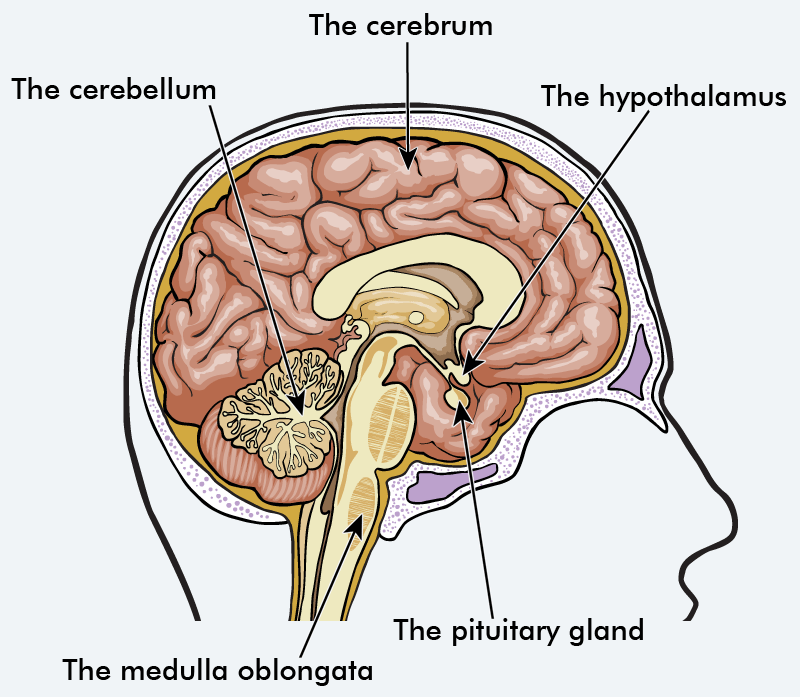

<p>The spinal cord is a structure consisting of nerve cell bodies and axons. This long and stem like structure operates as a pathway, taking sensory information to the brain and transmitting motor impulses from the brain to the muscles. The spinal cord controls all the body’s activities from the neck down and is also involved in simple sensor motor reflexes. Pulling our hand away from a hot, stove is an example of demonstration of a reflex, which is an involuntary response to a stimulus. Human beings have many reflexes all of which are supported by connections between sensory and motor neurons. These neurons are, as it appears, built into our systems through our genetic structure.<br />
Monosynaptic polysynaptic are the two basic types of reflexes. The simpler kind monosynaptic occurs as a result of direct connection between a sensory neuron and a motor neuron without any intervening interneuron. It has only one synapse between sensory input (what we feel) and motor output. (What we do). The familiar knee-jerk” (Patellar) or hot-stove reflex is in this category. Both kinds of neurons involved in this reflex &#8211; sensory and motor are located in the Spinal Cord. The’ brain does not directly involve and participate. Such demonstration is really dramatic in the way that we can make a response to sensory stimulus without being consciously aware of the stimulus.<br />
There are people (Paraplegics) whose lower limbs are paralyzed because of an injury to the ma1 cord. This injury has cut off communication between the brain and the spinal cord. Their brain does not receive sensory information from the spinal cord due to the injury.<br />
Resultantly, they do not feel pain even if something, ordinarily painful is occurring to the affected part of the body. The lade of the pathway from the brain to the spinal cord also prevents information from travelling along a pathway from the brain to the rest of the body. It, thus, prevents’ voluntary control over affected muscles. People with injured spinal cord do exercise some involuntary control; It is possible because of complete synaptic connections within the spinal cord. A paraplegic will, thus, still move ‘his leg away on a pinprick, even though he is not conscious of the sensation of pain.<br />
When we blink in response to a loud noise, pull back our hand from pain or contract the pupils of our eyes in bright light, we demonstrate a more complex polysynaptic reflex. The type of reflex involves many synapses all of which follow the same basic pattern of coupling between the sensory arid motor systems. The Spinal Cord of human beings is very similar to the structure in the lower animals. The organs that set us apart are our brain, especially the part of the brain tailed “cortex”.</p>
<h2><strong>Sympathetic Functions:</strong></h2>
<p>The sympathetic division works as a unit “in sympathy” to mobilize the body resources so that it can exp end energy. In response to a stress it produces “flight or fight” reaction in shape of mobilization. Thus the signs of physiological form in emotional states as fear, anger etc appears. The sympathetic activation makes our heart beat faster, breathing rapid and makes us sweeten. To fulfill the need of “vigorous activity and provide glycogen (oxygen and 1iucose) it directs blood from skin, and stomach to skeletal muscles end makes adrenal gland release epinephrine (adrenaline).</p>
<h2><strong>Parasympathetic Functions:</strong></h2>
<p>The main function of the parasympathetic division is to restore the body by increasing its supply of stored energy. This system carries out a dual function i.e. directing the blood to the stomach to promote digestion and slowing down the heart, at the time of meals or major eating. That is why we often advise people to avoid going for showers or taking to swimming. We warn rightly when so much blood has been diverted to the stomach that not enough reaches the muscles (through heart) to enable them to engage in strenuous exercise. Cramps may take place in such bodily state.<br />
Liza John is an IT professional from pass certification .Have you really looked for this 700-101 Practice Test Assistance? Move ahead to take the benefit of 1Z0-465 Practice Test and pass your exam easily.</p>

The Spinal Cord And Its Function