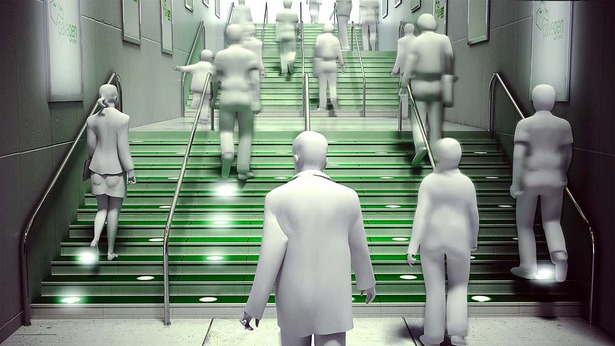

<p>Could a new power source be under our feet? Some architect firms are now investigating and developing the concept of harnessing the power of our feet as a energy source for low level requirements. We look at how these new devices work and whether it is scaleable as an alternative energy source.<br />
<strong>New potential energy source</strong><br />
The idea that we can generate energy from a number of alternative sources, even ski-slopes and skyscrapers, has been gathering momentum for some time, but a new source is now being further developed. The Facility, a London firm, has been investigating, for almost a decade, the ability to capture energy from the flooring that we walk over. Initially, the idea was developed as a solution for dampening down old parts of the railway in London that were particularly noisy. One of the ideas that this group of architects put forward was to put a series of small tubes into a rubber like flooring, when feet walked across it the tubes, which were filled with liquid, would move and the liquid would be pushed through a turbine to create power. It was thought that the energy created, although relatively low levels, would be enough to power some machines such as turnstiles, ticket machines or displays in stations with high footfall.<br />
<strong>London Olympics first to trial</strong><br />
Along with The Facility, another firm, PaveGen, was also researching the ability for footfall to generate energy. The slabs that have developed can be retro fitted into flooring areas; when the slab is stepped on a small burst of energy is released some of which powers the light in the slab, whilst the rest is saved to a built in battery to be redirected as appropriate. The opportunity for architects and interior designers to create aesthetically pleasing versions is now being investigated. These original slabs were used during the Olympic Games at a major shopping centre nearby and the power generated was used to light some of the external lighting at the centre.<br />
<strong>But is this a scale-able option?</strong><br />
Critics to these new systems argue that not enough power will be able to be generated and that therefore they a not a viable alternative option. Two Americans have now stepped in and are developing what they see to be a solution to this issue entire roads would house solar panels that they argue would produce three times the energy that the US currently needs a bold claim indeed. Architects and interior designers could then develop whole roads and housing communities that in theory would just plug into their road outside for their energy needs.<br />
Developing this as an alternative energy source seems to be stuck at a crossroads at the current time; on the one side, the power being produced appears to be too small scale and not viable as an alternative option, whilst the other side would see architects and interior designers creating an entire new road and housing network of a country. Which side is more viable? We shall have to wait and see.<br />
<strong>AUTHOR BIO</strong><br />
Tony Right is a freelance architect who specialises in developing sustainable project designs for a wide range for private clients; to find out more click here.</p>
<div><span style="color: #222222; font-family: arial, sans-serif; line-height: normal; background-color: #ffffff;"> </span></div>

The search for new, green, energy sources