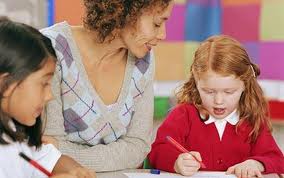

<p style="text-align: justify;">Primary school teachers are responsible for the education of children from the age of three to 11. In England and Wales these age groups are usually divided into lower primary, which refers to the Foundation Stage (ages 3 to 5) and Key Stage 1 (ages 5 to 7), and upper primary, which is Key Stage 2 (ages 7 to 11).</p>
<p style="text-align: justify;">The role of primary school teachers is to establish a good relationship with pupils and organise their learning resources and classroom environment to ensure the best learning outcome. They work to facilitate the optimum development of their pupils and to foster and encourage their learning in line with the National Curriculum.</p>
<h3 style="text-align: justify;"><strong>Primary Teachers have a Number of Duties:</strong></h3>
<ul style="text-align: justify;">
<li><strong>Lesson planning –</strong> Primary teachers have to prepare lessons in accordance with the goals of the National Curriculum. Lessons have to be designed to be stimulating and to encourage pupils to take a full part. Teachers must accommodate a range of abilities in each lesson to keep all pupils engaged.</li>
<li><strong>Classroom management –</strong> Children of primary school age sometimes let their enthusiasm get the better of them. They can be excitable and often exhibit limited concentration. The teacher must be able to command the respect of the pupils and to maintain discipline.</li>
</ul>
<p><img class="size-full wp-image-20062 aligncenter" src="https://haznos.org/wp-content/uploads/2013/06/index.jpg" alt="" width="290" height="174" /></p>
<ul style="text-align: justify;">
<li><strong>Outside activities –</strong> In the life of the primary school, there are usually a number of outside activities during the year. These include sports events, outings and other social functions. Teachers are expected to help with the organisation and supervision of these activities. They have to assess risk and cost and to ensure that the appropriate permissions are obtained.</li>
<li><strong>Administration –</strong> Teachers have to cope with a good deal of administrative paperwork. Records have to be kept and reports on the progress of children must be made. They will also be expected to contribute to staff meetings, meet with parents and sometimes liaise with other childcare professionals as needed. There is student work to be marked and assessed and, occasionally, professional training to be undertaken.</li>
</ul>
<p style="text-align: justify;">Primary teachers are, of course, highly qualified professionals. Most commonly, they need to have a first degree, a post-graduate award or to have followed a work-based programme to be considered for the role. After this, they will need to undertake Initial Teacher Training and then gain Qualified Teacher Status. Entry to degree courses usually requires a minimum of five GCSE passes at Grade C or above, including English, Mathematics and a science subject, and passes in three subjects at A Level. Also, all candidates for teaching posts are subject to background checks with the Disclosure and Barring Service.</p>

The Role Of The Primary School Teacher