
<p>It seems that just when society is starting to really lament the modern childhood wasted in front of screens instead of outdoors playing, a wave of initiatives comes along to try and get every child a personal laptop for their schoolwork. There are plenty of schemes to integrate IT with learning across the globe. For example, if you’re looking for a new laptop or ultrabook, you can donate your used laptops to Computers for Classrooms, who will then distribute them. There are wind-up electronic word processors distributed in rural African schools and the recent launch of a specialist tablet by Amplify that is custom-made for use in the K-12 classrooms of America.<br />
Proponents of these schemes have argued that personal laptops facilitate the early learning process. Sophisticated computer programs are seen as a way to engage children with their education by appealing to their love of gadgets and “cool technology”. In pilot studies in the USA their inclusion had a positive influence on students, increasing academic achievement and motivation. In 1998, Stevenson reported that a higher level of motivation was most noticeable amongst traditionally “at-risk” student populations.<br />
The use of Instant Messenger programs or discussion forums is seen as a way to improve communication between students and educators, as well as communication amongst peers.<br />
In a society where computers are an integral part of professional and personal life, it makes sense for children to become confident in using these tools now if they want to do well in their future workplace. As traditional jobs adjust to new technology and computers are no longer the preserve of ‘professional’ skilled careers, so too should education adjust to familiarize everyone with them.<br />
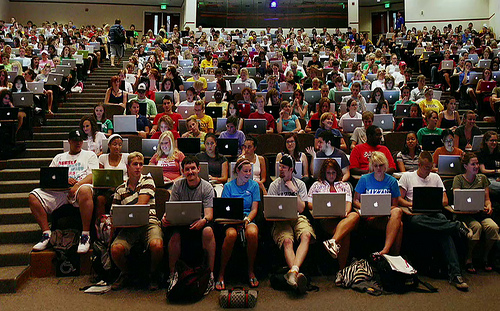
What are the drawbacks of this approach to digitizing education? Does the universal inclusion of laptops really make a positive difference to a school kid’s development? A research study by Hembrooke and Gay in 2003 showed that higher education students with their laptops left open during a class – allowing them the freedom to browse and complete tasks on their computers, among other things – remembered less content than another group of students who had kept their laptops closed for the duration of the lesson. When students have the freedom to play with a computer in front of them, they end up paying less attention to what the teacher is telling them.<br />
The well-established criticism of too many computers in schools is that it encourages children from a younger age to spend time in front of a screen, remaining inactive. With long periods indoors with little physical activity, K-12 students will be setting themselves up for bad habits, poor health and socializing difficulties for later.<br />
Ever since technology more advanced than the abacus has come into the classroom, critics have argued that the younger generation is losing the ability to calculate complex answers for themselves, becoming more reliant on gadgets to yield quick answers. Perhaps this is a problem in the education system in itself rather than a side effect of the tools that system uses: laptops are unlikely to be the cause of a widespread loss in critical thinking, although using them might emphasize the development of an alternative skill set.<br />
Universal laptop access is a relatively new concept, and more time is needed before the long-term research studies can reveal if the academic benefits to those involved last longer than a couple of years.</p>

Laptops in the Classroom – Revolutionizing Education or Causing Distractions?