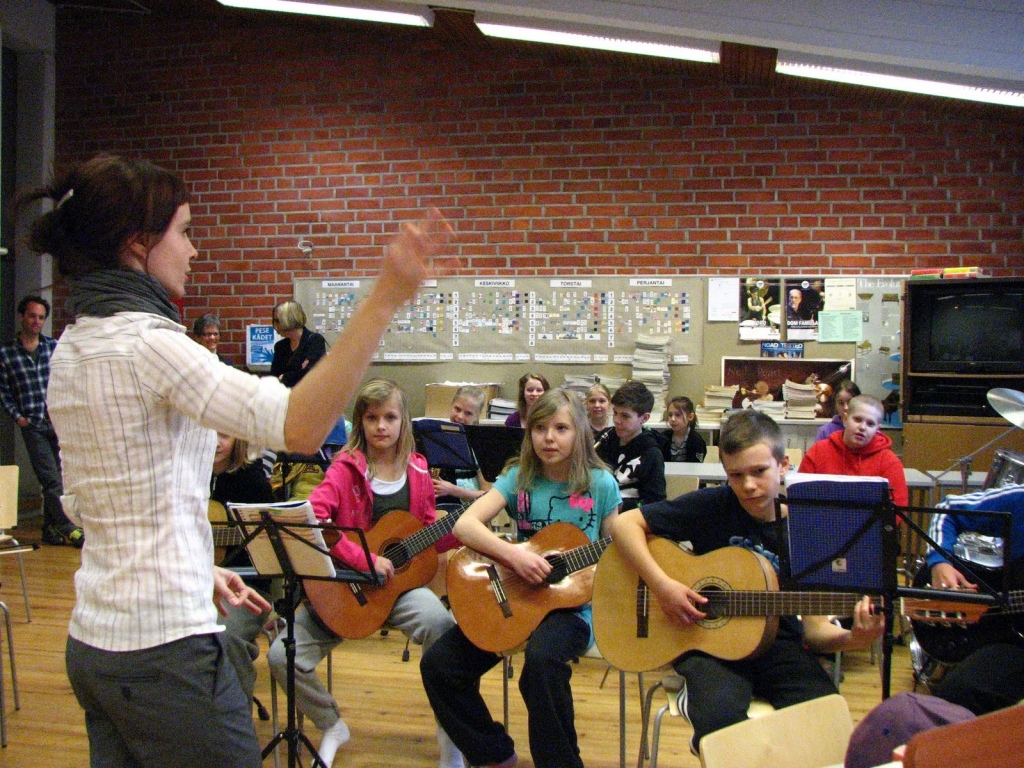

<p>Finland is something of a mystery – beautiful scenery, the midnight sun, the famous Lapland, Angry Birds and, of course, Nokia are all that many people have heard of. But in recent years Finland has been lauded for the success of its education system. In PISA surveys, Finnish students have consistently outperformed those from other western nations and are on a par with the best in Asia. So what is it about studying in Finland that brings about these results? These facts about Finland’s education system might help to explain:</p>
<ul>
<li><strong>Casual approach.</strong> To outsiders, schools might appear rather casual. Students do not wear uniforms, often walk around barefoot (as they do at home), have lounges where they can relax and are on first name terms with teachers. This is designed to create a nurturing, homelike environment.</li>
<li><strong>Minimal homework.</strong> Unlike their counterparts in Asia where students spend hours every day slaving over homework, Finnish students seldom have more than half an hour’s homework a day.</li>
<li><strong>Loose curriculum.</strong> Although there is a national core curriculum, schools and teachers are allowed to adapt education to local conditions and can tailor learning to the needs of individual children.</li>
<li><strong>Motivated teachers.</strong> Teachers in Finland have a high social status – on a par with lawyers and doctors – and all have Masters Degrees. Some 25% of high school graduates aspire to become teachers but only around 10% of applicants are admitted to the teacher training programmes.</li>
<li><strong>Less learning time.</strong> Students have fewer school days than their counterparts in 85% of other developed countries and teachers work far fewer hours than those elsewhere (around 570 hours a year, which is just over half as many as teachers in the United States, for example).</li>
<li><strong>Limited testing.</strong> Students are not usually graded until they reach 9 or 10 years of age and there is only one standardised mandatory test, which is taken when they are 16. At this stage, they choose between academic or vocational education.</li>
<li><strong>High graduation rate.</strong> The high school graduation rate in Finland is over 90% and nearly two thirds of graduates are accepted for tertiary education, the highest rate in Europe.</li>
<li><strong>Class sizes.</strong> Finnish schools have an enviable student teacher ratio that ranges between 16:1 and 25:1. Science classes are kept small enough to allow all students to perform all science experiments.</li>
<li><strong>No special treatment.</strong> Classes comprise students of all abilities – there is no streaming based on ability. In fact, competition between students is discouraged.</li>
<li><strong>The academic achievement gap</strong> between the strongest and the weakest students is the smallest in the world.</li>
<li><strong>No ranking.</strong> Schools in Finland are not ranked and teachers do not undergo formal reviews. This leaves them free to focus on teaching rather than worry about their performance.</li>
<li><strong>Free education.</strong> Education at all levels in Finland is free. Also, although formal education is compulsory only between the ages of 7 and 16, toddlers have the right to attend free pre-school where the focus is on developing social skills and self-reliance – reading is not approached until the age of 7.</li>
<li><strong>Extra tuition.</strong> Struggling students receive free extra tuition. Teachers are paid by the hour so the additional work is rewarded.</li>
</ul>
<p>Whatever the secret, Finland’s education system achieves enviable results. And, when considered in conjunction with excellent amenities, good standard of living and wonderful environment, is just one more reason that finding work in Finland is a great option.</p>

Fascinating Facts About Finland’s Education System