
<p>The Federal Motor Carrier Safety Administration (FMCSA) is planning for significant changes regarding EOBRs and hours of service compliance in 2013. While the transportation re-authorization bill titled Moving Ahead for Progress in the 21<sup>st</sup> Century (MAP-21) went into effect on Oct. 1, 2012, several developments are taking place before it will be fully implemented. Enforcement of MAP-21 is expected by 2016, pending the passing of measures regarding hours of service, driver harassment/coercion and privacy issues.<br />
<strong>Compliance with the Law</strong><br />
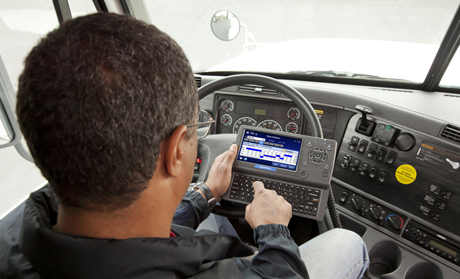
EOBRs will be mandated in the implementation of MAP-21. These real-time fleet tracking systems document driving time, duty status and impending or actual violations. However, given the expense of EOBRs and the time needed for training for these systems, managers and drivers alike wonder if other options for being compliant will come to fruition.<br />
<strong>Electronic Driver Logs Vs. Manual Driver Logs</strong><br />
Currently, all drivers who travel beyond a 100-mile radius must maintain manual driver logs. Following the implementation of MAP-21, these drivers will be mandated to use electronic driver logs (or, more accurately, EOBRs). Presently, with manual driver logs, a driver has to complete the paperwork by hand, which is time consuming. Additionally, drivers have more of a liberty to record times and destinations incorrectly either from error or purposely.<br />
These issues are remedied by EOBRs, which are real-time review and audit systems. Drivers will be monitored actively to determine their hours of service, location, availability and overall compliance with MAP-21 regulations.<br />
<strong>Alternatives to EOBRs</strong><br />
According to Omnitracs, EOBRs will become a requirement for any driver who currently is subject to paper logs. Therefore, it’s pretty clear that the MAP-21 compliance will solely be maintained through EOBRs. Hypothetically, alternatives that could be considered for documentation of drivers and deliveries would be other fleet tracking systems. For instance, passive systems, such as tablet-based logbooks and handhelds, could be used to input data regarding mileage, hours of service and delivery acceptance.<br />
Additionally, passive systems are less costly in comparison to active systems that include EOBRs. Paper logbooks are another alternative, which is by far the least expensive. However, these have clearly been overruled by the new legislation since they can also be forged and are really just electronic versions of handwritten logbooks.<br />
<strong>Pros and Cons to EOBRs</strong><br />
Any company implementing EOBRs or alternative fleet tracking systems should consider the benefits for their business overall. EOBRs provide real-time data regarding fuel usage, delivery routes, weather conditions and driver activity. Businesses can take advantage of this information to streamline their supply chain. Yet, many seasoned drivers are certain to resist the implementation of EOBRs because they see it as a new system that tracks their every move. Addressing EOBRs and the new requirements as a way to improve driver safety, delivery routes and time efficiencies will help minimize the negative connotations associated with these changes.<br />
<strong>Differences in Regulation</strong><br />
Not all businesses will be affected by the legislation of MAP-21. Drivers transporting agricultural commodities and farming supplies are exempt from this law as noted by Section 32101 of MAP-21. This statutory exemption applies to those working as farming or ranching operators and employees who operate covered farm vehicles. Otherwise, all brokers and freight forwarders must register with the FMCSA, and are thereby held to the regulations of MAP-21.</p>

EOBRs Mandated for Most Truckers by 2016