
<p>We live in an age which, a hundred years ago, would have seemed like science fiction to the man on the street. In fact, it was; Jules Verne – of 20,000 Leagues Under the Sea, among other science fiction tales – envisioned submarines, travel to the moon, and even the Internet, all of which were developed long after he passed away.</p>
<p style="text-align: center;"><img class="aligncenter" src="http://myblogguest.com/forum/uploads/articles/2013/9/shutterstock_123446515_1.jpg" alt="" width="600" height="900" /></p>
<p>As a society, we have come a long way. 100 years ago America was finishing up its subjugation of Native Americans and gearing up for a ginned-up war in Cuba. Meanwhile, poverty ran rampant among the lower classes, with nary a law against child labor, and women did not yet have the right to vote. It was, in other words, a seemingly barbaric time when considered from the perspective of our modern sensibilities.<br />
We often feel superior in the knowledge that we are so well advanced beyond those times that we forget how much of an eye-blink in history a century really is. We are not, in fact, very removed from those times. All the advancements in technology that we enjoy today, for example, are really the product of a seemingly common sense and quite elementary development in manufacturing methods towards the end of the industrial revolution: the assembly line.</p>
<p style="text-align: center;"><img class="aligncenter" src="http://myblogguest.com/forum/uploads/articles/2013/9/shutterstock_15284887.jpg" alt="" width="600" height="423" /></p>
<h3><strong>Early Mass Manufacturing</strong></h3>
<p>(IMAGE: Temple of Heaven)<br />
The idea of the assembly line is one that has been rediscovered, redeveloped, and rediscovered again and again throughout history. Each time, it has grown closer to the assembly line method of manufacturing we use today.<br />
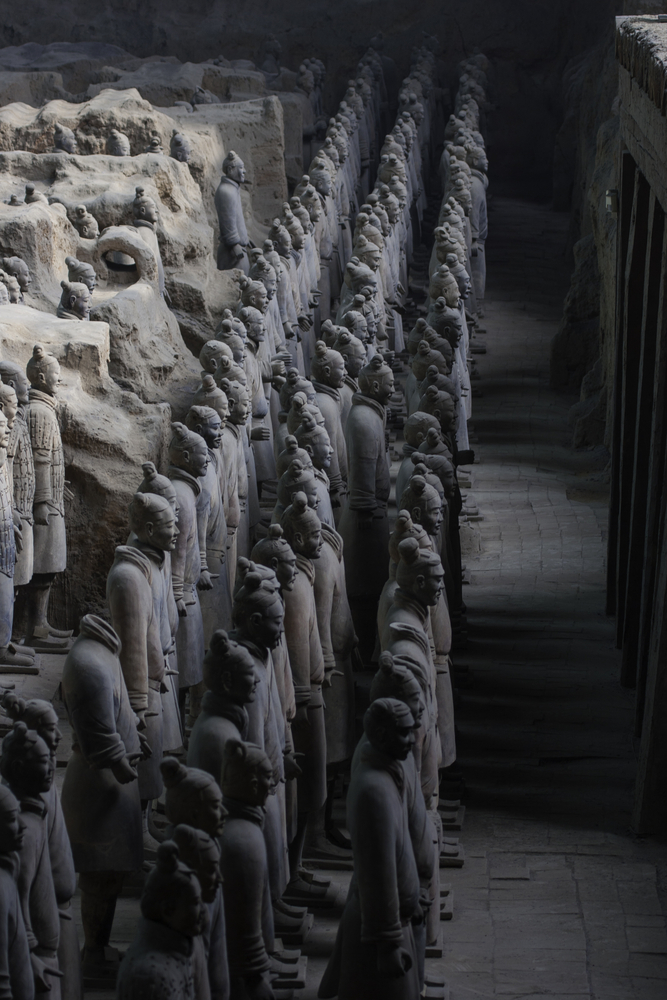
It may come as no surprise that one of the earliest examples of mass manufacturing occurred in China, some 2000+ years ago. The Terracotta Army, which tourists still come from around the world to see today, was commissioned by Emperor Qin Shi Huangdi and constructed by different workshops manufacturing the individual body parts for the ceramic soldiers and horses that compose the Army. These pieces were later put together for the Emperor’s burial with the Terracotta Army.<br />
This early example of assembly line manufacturing demonstrates one of the key strengths of the assembly line: the ability to produce the same piece again and again in an efficient manner, later using each of those pieces to construct the final product. This has proven more efficient in terms of both time and labor when compared to producing the entire final product, one at a time. This later came to be known by Adam Smith as the “division of labour.”</p>
<p style="text-align: center;"><img class="aligncenter" src="http://myblogguest.com/forum/uploads/articles/2013/9/shutterstock_94202290.jpg" alt="" width="600" height="446" /></p>
<h3><strong>Mass Manufacturing Meets Machines</strong></h3>
<p>Many other examples of the assembly line can be seen throughout history, but the technique did not really change until the advent of the industrial revolution. Although we talk about the industrial revolution like it was an event, it was in fact a long serious of changes in how we approached manufacturing, occurring over hundreds of years and in many different places.<br />
(IMAGE: Cog and Wheel)<br />
The division of labor became key to the success of the industrial revolution. Eli Whitney, of cotton gin infamy, developed the idea of the armory system of manufacturing in 1801, using the division of labor, interchangeable parts, and engineering tolerance. The advent of conveyor systems allowed these different techniques of mass manufacturing to roll right along.</p>
<p style="text-align: center;"><img class="aligncenter" src="http://myblogguest.com/forum/uploads/articles/2013/9/shutterstock_103035632.jpg" alt="" width="600" height="399" /></p>
<h3><strong>The Modern Assembly Line</strong></h3>
<p>(IMAGE: Factory Workers)<br />
The most famous implementation of the assembly line is that of the Ford Motor Company. The Ford Model T, perhaps the most famous car in America, was built on an assembly line. The efficiency that this system produced led to the proliferation of the assembly line throughout the automotive industry, rendering cars more affordable and easier to mass produce. Thus was our automobile culture born.<br />
The assembly line has seen several changes over the years since Ford began constructing to Model T, including the introduction of robots that can perform many of the assemblage function that humans once did. More and more, the role of people on the assembly line is that of specialists or repair, though many companies still use people on assembly lines for finer work.<br />
Though the assembly line has many critics, Ford succinctly pointed out that while like many new technologies the assembly line had its problems, those were ultimately outweighed by the benefits of it brought. With an assembly line, workers did no heavy lifting, nor did they do stooping or bending; no special job training was required, and so unskilled workers who might otherwise have no prospects could find gainful employment on an assembly line. To this day, the assembly line remains not just an important part of modern manufacturing, but key to the employment and improvement of life for workers in developing nations like Mexico, Brazil, and yes, China.<br />
(IMAGE: Industrial Worker)<br />
<em> </em></p>
<h5>Citations:</h5>
<ul>
<li>Dorner Conveyors has helped aid technological advancements by offering its customers quality precision conveyor systems for the last 44 years.</li>
</ul>
<h5>Featured images:</h5>
<p><span class="license">License: Royalty Free or iStock</span><br />
<span class="source">source: http://www.shutterstock.com/pic-123446515/stock-photo-temple-of-heaven-beijing-china.html</span><br />
<span class="license">License: Royalty Free or iStock</span><br />
<span class="source">source: http://www.shutterstock.com/pic-15284887/stock-photo-cog-and-wheel-details-from-machines-of-the-industrial-revolution.html?src=SezUYugKx7WbfREHqCt0fw-1-3</span><br />
<span class="license">License: Royalty Free or iStock</span><br />
<span class="source">source: http://www.shutterstock.com/pic-94202290/stock-photo-factory-workers.html</span><br />
<span class="license">License: Royalty Free or iStock</span><br />
<span class="source">source: : http://www.shutterstock.com/pic-103035632/stock-photo-adult-experienced-industrial-worker-during-heavy-industry-machinery-assembling-on-production-line.html</span><br />
<span class="license">License: Image author owned</span><br />
By Joshua Cranmer<br />
<em>T.M. Loyd is a freelance writer from Lancaster, Pennsylvania, who has been published across the web on topics ranging from manufacturing trends to packaging solutions for companies like Morrison CHS. </em></p>

Assembly Lines: A New Approach To An Age Old Invention