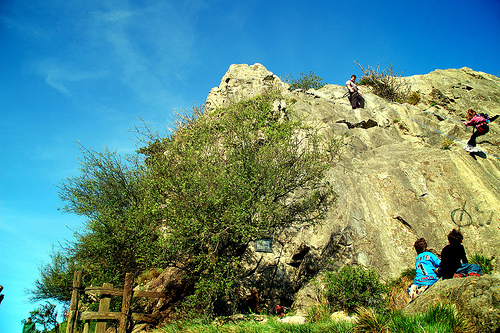

<p>Did you know that the fear of heights is not called vertigo? It&#8217;s actually called <em>acrophobia</em>. According to a 1997 study, acrophobia affects up to 5 per cent of the population.<br />
Those people are unlikely to want a job that involves working at a height,<br />
but others positively relish the chance to expose themselves to jobs that will take them to high places &#8211; literally.<br />
If you want to work a little danger into your career, you could try putting recreational skills, such as abseiling or climbing, to good use.<br />
Extreme sports fans can be a valuable asset to any company looking for staff that will go the extra mile &#8211; often vertically.<br />
But how can you use these skills?</p>
<h2>1. High Rise Window Cleaning</h2>
<p>The most common abseiling technique involves descending backwards down a cliff, so abseiling lends itself nicely to window cleaning.<br />
(There are various alternatives used for different purposes; in Australian rappel, the brave participants descend facing the ground).<br />
Not all window cleaning companies employ staff that are qualified to abseil down buildings, simply because it’s such a specialist skill, and many firms rarely deal with skyscrapers.<br />
Those that do will tend to serve city areas with a large number of high-rise buildings.<br />
Abseil window cleaning is only used in areas where other techniques and equipment would be impractical.<br />
The commercial window cleaning company will need to assess the premises for suitable anchor points, and where none exist, abseilers can arrive with their own mobile anchor equipment.<br />
All of this makes abseil window cleaning expensive, but in some situations, it’s the only way the job can be done.</p>
<h2>2. Crane Operating</h2>
<p>Crane operators obviously deal with heights on a daily basis, and the sight of someone working in a tiny cabin on a crane can strike fear into any acrophobic.<br />
But nothing compares to the extreme challenge of working a crane bolted to the side of a high-rise building.<br />
With the drive for bigger buildings comes the increasing risk associated with crane work.<br />
Dubai is well known for its thirst impressive, ambitious construction projects.<br />
The Burj Khalifa is perhaps the best known. It’s the world’s tallest skyscraper, and it towers 828 metres above ground.<br />
According to rumour, one man, Babu Sassi, worked and lived in a crane balanced on top of the massive building for a year.<br />
Sassi is rumoured to have spent day and night in his crane cabin because the journey up and down was too time consuming.<br />
According to hearsay, he was also paid significantly higher wages to compensate him for the risks he took.<br />
Sassi’s story may or may not be entirely true. But onlookers say that when the work was complete,<br />
the crane he’s said to have operated had to be dismantled using a helicopter because it was completely inaccessible.</p>
<h2>3. Steeplejacking</h2>
<p>Steeplejacking is associated with centuries of maintenance on churches and places of worship in the UK, and<br />
skilled steeplejacks also work on lighthouses, bridges and other tall structures.<br />
Rather than using rope to descend, steeplejacks historically used complex lattices of ladders and a wide seat to enable them to climb and carry out repairs.<br />
Modern health and safety laws generally prohibit free climbing,<br />
so steeplejacks tend to use ropes, and the falling cost of modern methods is causing traditional steeplejacking to die out slowly.<br />
However, steeplejacks are still used in modern industry to work on churches and chimneys around the world.</p>
<h2>How Do I Train For an Extreme Job?</h2>
<p>Interested in a career that involves abseiling? You’ll enjoy plenty of adrenaline-boosting experiences, but you’ll need to be formally trained.</p>
<ul>
<li>The Industrial Rope Access Trade Association (IRATA) offers a variety of training schemes that will put you in line for that dream job.</li>
</ul>
<ul>
<li>If you want to keep steeplejacking alive as a trade, the Association of Technical Lightning and Access Specialists (ATLAS) can point you in the right direction.</li>
</ul>
<h5>Featured images:</h5>
<p><span class="license">License: Creative Commons</span><br />
<span class="source">image source</span><br />
Brad Staines is an expert in abseil window cleaning. He is the MD of Aquamark, a window cleaning company in the UK.</p>

3 Extreme Careers That Require A Head For Heights